
Crafting a Better Future by Doing What’s Right
A Recipe for How Democrats Can Actually Deliver Again & Restore the American Dream

The Democratic Party is at a crossroads. The battle for who we are and what defines us is being shaped not primarily in Washington, DC, but in campaigns across the country—including right here in Maine. Our races for the U.S. Senate, the 2nd Congressional District, and the Governor’s mansion are some of the closest-watched of any in the nation.

Over the past several months, I’ve traveled across the state, dedicating time to listen to my fellow Mainers. Although I won’t be a candidate on the 2026 ballot, the conversations have been incredibly insightful. In reality, these kinds of conversations have been central to my life for years, ever since we opened Maine Beer Company back in 2009. Customers started coming through our doors to enjoy a break from the grind of a daily life that has only gotten more difficult. It’s more expensive than ever: housing, health care, electric bills, and groceries are all harder to afford.
In short, the American Dream has become a myth.
Not only that, it’s more difficult than ever to have civil discussions with neighbors and family members. This is a dangerous consequence of a toxic political culture that paints those with different perspectives as the enemy, social media companies that have stoked division, and a global pandemic that has driven us away from each other. We need to get back to disagreeing with each other respectfully, hearing each other out, and simply treating others the way we’d like to be treated.
I’ve been reflecting on how we can make life better for Americans across the country and how we, as Democrats, can connect once again with a majority of voters who have more common sense than anyone you see down in Washington. My answer comes back to the simple motto my brother and I have had since starting our business: Do What’s Right.

It’s painted on our walls, printed on our labels, and baked into every decision we make—from how we source materials, to how we treat the people who work with us, to how we show up for our community. But “Do What’s Right” is more than a business philosophy; it’s our North Star. At this moment in our history, we need more leaders willing to articulate clearly what “right” looks like to rebuild trust and give people a sense of security and possibility again.

That’s why today I’m releasing this blueprint—a guide for how our Party can deliver for our state and country in a way that works for workers, small businesses, and young families trying to build a future. In this moment of reckoning, it is a statement about what the Democratic Party should do next: address fundamental economic insecurity felt by ordinary Americans; foster a new era of opportunity; and restore trust through accountability and integrity. It’s about restoring faith in the American dream.
I brew beer for a living, and I know that if the inputs aren’t right, the outcome won’t be either. We need a new recipe for our Party. Here are the five steps in the recipe for crafting an effective Democratic Party that can deliver again:
Make Life More Affordable
Treat Workers Well
Empower Small Businesses
Accelerate the Clean Energy Transition
Restore Trust Through Good Governance
1. Make Life More Affordable
One thing I hear everywhere I go is that life feels more expensive and less predictable. Housing, heating, healthcare, and education costs are squeezing families. On top of that, Washington keeps injecting uncertainty into the economy—most recently with a chaotic, haphazard approach to tariffs.
As someone running a brewery, I’ve seen the damage firsthand. Maine Beer Company’s bottles come from Germany, our caps from Mexico, our brewing equipment from Canada and Europe, and even basic building materials cross borders. The uncertainty created by sudden and constantly changing tariffs makes it difficult for us to plan ahead. Our suppliers won’t guarantee prices. We don’t know how much to borrow. We can’t make growth decisions with confidence. Coming after several years of COVID-era economic instability, the psychological toll on small businesses like ours has been immense.
Here are ways we can address this challenge:

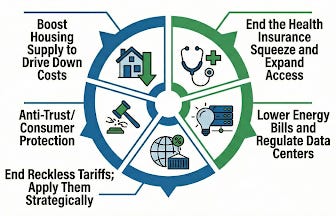
Boost Housing Supply to Drive Down Costs
Housing is an urgent issue that impacts all life decisions, especially for a generation struggling with rent and homeownership. Lack of housing security prevents risk-taking and entrepreneurial pursuits because people lack the foundation, assets, and stability to invest in their futures. We should focus on subsidizing supply, not demand.
We need to consider a range of bold, creative ideas to finally break this logjam. Let’s encourage “missing middle” housing like duplexes and ADUs over single-family mandates. Let’s streamline permitting processes and consider innovative, modern modular construction technology to lower costs and more quickly boost supply. I’m interested in exploring concepts like portable mortgages, defeasance accounts, and capitals gains exceptions for some sales, all of which could incentivize “locked-in” homeowners to move or downsize. Other promising ideas include conditioning federal grants on local building targets to address NIMBYism and providing direct financial benefits to residents. While further analysis of the costs and benefits of these proposals is necessary, we must recognize that this persistent crisis cannot be solved by relying on the same outdated ideas.
End the Health Insurance Squeeze and Expand Access
With the expiration of the enhanced Affordable Care Act subsidies on January 1, 2026, the “middle-class squeeze” has officially become a full-on suffocation for families and small business owners across Maine. It is simply not right that hardworking Mainers are seeing their health insurance premiums more than double overnight while politicians in D.C. fail to provide a lasting solution. Instead of protecting our health, politicians in D.C. are diverting our tax dollars away from the healthcare system to fund militarized immigrant enforcement agencies that threaten our neighbors and tear communities apart.
As someone who has spent the last sixteen years at Maine Beer Company proving that you can grow a successful business while covering 100% of your employees’ health insurance premiums, I know that affordable care is essential. Something we should do is broaden Medicare coverage for those under 65 with a public option. We also need to empower our entrepreneurs by facilitating large insurance pools that give small businesses the same negotiating power as the biggest corporations, ensuring that no one is forced to give up on their dream because they can’t afford a decent health plan. We must stop the endless ideological debates and deliver the practical, results-oriented leadership that lowers costs for everyone.
Anti-Trust/Consumer Protection
For too long, the rules of our economy have been written to cater to the biggest players, leaving workers, small businesses, and consumers to pay the price. As a national leader of the craft brewing community, I’ve seen this firsthand; we had to fight tooth and nail to reform outdated laws designed to protect big beer companies just so we could get our product to market. This lack of competition is an affordability crisis, not just a problem for businesses. When markets become concentrated, whether it’s through massive grocery company mergers or media giants like Netflix and Warner Bros combining, boards and shareholders gain total control over pricing while consumers lose their power of choice. We need to embrace a new philosophy of antitrust enforcement that prioritizes consumer sovereignty over Wall Street profits. This means blocking reckless mergers that drive up grocery bills and ensuring the federal government doesn’t put its finger on the scale for political favorites. By empowering Main Street and fighting for a fair, competitive marketplace, we can restore the American dream and give Mainers the choices and lower costs they deserve.
Lower Energy Bills and Regulate Data Centers
Energy prices nationwide are already too high, and Maine in particular has some of the steepest electricity rate increases in the country. Many families will face a significant increase in home heating bills this winter. Wind and solar paired with battery storage remain the fastest and least expensive way to add electrons to the grid and keep rates from rising further. In addition to adding supply, we should restore and extend federal energy efficiency programs that reduce demand from households.
Yet the rapid growth of data centers poses a serious risk of pushing costs higher. No household or small business should pay more because a data center comes in and consumes massive amounts of power. We must require data centers to adopt sustainable, grid-friendly practices—prioritizing projects that use demand response, generate power on-site, and locate near transmission lines. To win the global AI race, the U.S. must take the lead. However, technology companies—or “hyperscalers”—should not be allowed to externalize the costs of achieving this AI future onto the public.
End Reckless Tariffs; Apply Them Strategically
President Trump’s application of across-the-board tariffs on common consumer goods, including groceries, represents a tax on consumers. Tariffs are appropriate only when applied strategically to protect national security (e.g., ensuring domestic production of steel, food, or critical materials). Currently, we have a president using tariffs as a political weapon rather than following the constitutional process. Families, investors, and small businesses need clarity and long-term consistency so they can plan for the future.
2. Treat Workers Well
At Maine Beer Company, our workers are the business. If they thrive, we thrive. And what I hear from them—from brewers to hospitality staff—is simple: It’s getting harder and harder to make a life here. Housing costs are crushing, benefits are too expensive, and people delay having families. This story plays out in much the same way virtually everywhere across the United States. That’s not the reality I want for my kids or anyone else’s.
Here are ways we can address this challenge:

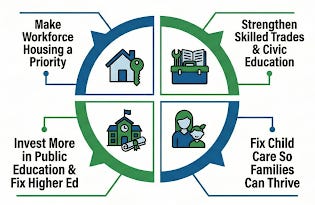
Make Workforce Housing a Priority
When I chat with the team after hours, the same story keeps popping up. Either they’re renting, or they’ve had to buy homes so far out that the drive is killing them. Even if they can cobble together a down payment and get a home, they’re struggling to afford the mortgage, and God forbid they have to shoulder the cost of a major repair like a new roof or boiler. Housing just eats up too much of everyone’s money, forcing them to make hard calls. People are skipping vacations, putting off starting families, and delaying medical procedures for years.
We seriously need to deal with this human cost ASAP. I’ve suggested some policy fixes, but right now, we need to concentrate on building more places to live closer to where the jobs are. This is key to getting people out from behind the wheel for hours every day. When our employees can live nearby, they become more connected to the community—they put down roots and get involved in their neighborhoods.
Strengthen Skilled Trades and Civic Education
We really need to do more to encourage kids to pursue the skilled trades and give a big boost to young folks looking into fields like carpentry, electrical work, welding, and auto mechanics. Why? Because a standard four-year college degree just doesn’t offer the bang for the buck it used to, while these trades are proven routes to a great income and fulfilling career. According to a November study from the Federal Reserve Bank of Cleveland, the difference in unemployment rates between college graduates and high school graduates is the smallest it has been since the late 1970s.
Hands-on experience, like what you get in a high school shop class, is so important for building real-world skills. We’ve got to invest heavily in trade schools and vocational programs—think wood shop, auto shop, and mechanics—so students actually graduate with practical skills that make them career-ready for jobs that are largely safe from being taken over by AI.
This commitment should absolutely include community colleges. Maine’s governor, Janet Mills, set a fantastic example by using COVID relief funds to give Maine students two years of free community college. That’s a blueprint we should be expanding on, both in our own communities and nationally.
Further, a big part of what we need to do is get back to focusing on civic responsibility. Making civics a required subject in high school is a must. On top of that, I’m a huge believer in national service. Not every kid is ready to jump straight from high school to college—I know I wasn’t. We should give young people a good reason to get some real-world experience by living and working in different communities across the country. We should treat national service as a high-value opportunity, incentivized, to make domestic civil service a serious, viable path alongside military service.
By completing a term of service in fields like conservation or infrastructure, participants would earn full tuition coverage to a two-year community college or a four-year degree. This allows young people from all backgrounds to invest in their country while simultaneously investing in their careers. This national service idea would not only set them up better for the future, but it would also be a really effective way to start closing the divides we’re seeing in our society today.
Invest More in Public Education & Fix Higher Ed
In Maine, data shows we’re falling behind, especially for kids from low-income or rural backgrounds. We need to start treating our teachers with the same respect we give to any other essential profession, and that starts with their paychecks. On average, teachers earned approximately 73 cents for every dollar to the earnings of other similar professionals in 2024. Right now, too many states are forced into an impossible choice between funding our schools or providing healthcare, which is why there must be a stronger federal role in supporting our educators. I support a federal matching program—similar to how we handle Medicaid—that provides federal dollars to states that commit to raising teacher salaries, ensuring that states with fewer resources aren’t left behind while still allowing local communities to maintain control over their own schools.
This is about doing what’s right by tying higher wages to clear performance standards so that parents and taxpayers see real results in the classroom. By combining these matching funds with common-sense incentives like student loan forgiveness for those who commit ten years to our schools, we can fix the teacher shortage and finally give our educators the professional dignity they deserve.
We also have to address the runaway cost of higher education. While I sympathize deeply with students graduating under a mountain of debt—I paid for school myself and finished nearly $200,000 in the hole—we have to be honest that student loan forgiveness is a band-aid, not a cure. The underlying problem is that tuition has become absolutely nuts because the current system of government-subsidized loans essentially incentivizes colleges to keep raising prices. These institutions are sitting on multi-billion dollar endowments while their campuses start to look more like luxury country clubs than centers of learning, and they take advantage of the fact that the government continues to foot the bill.
Simply forgiving the debt without addressing why it’s so high in the first place just rewards this behavior and does nothing to stop the next generation from being saddled with the same financial burden. We need rigorous reform that includes holding universities accountable for their costs and ensuring that an education is actually a path to opportunity rather than a lifelong debt sentence.
Fix Child Care So Families Can Thrive
The childcare system is fundamentally broken. The high cost, often comparable to a second mortgage, puts an immense financial burden on families—a problem that has persisted since my teenage twins were young. I remember there would be stretches of days where my wife and I would hardly see or talk to each other as we handed our kids off heading out to our respective jobs. Families in Maine pay up to $15,444 per year for infant care and as much as $13,260 annually for care for a four-year-old.
Simultaneously, dedicated caregivers are not fairly compensated for their essential work. According to data from 2024, the average hourly wage for caregivers in Maine was $16.63. Nationally, the average hourly wage was $15.93. This failing system severely impacts family well-being and acts as a significant drag on economic growth.
Having affordable, reliable childcare isn’t some nice-to-have; it’s basic infrastructure, plain and simple. It lets people start families and build their careers. This should be a no-brainer that everyone can get behind: young parents just need policies that make their lives easier. When parents have good care options, they get more done, and businesses benefit. So, putting money into childcare is a wise move for both our society and our economy—it pays off big time.
3. Empower Small Businesses
No country does entrepreneurship better than the United States. But there are still too many hurdles holding back those with innovative ideas. Small businesses are the heart of our country’s economy, yet we make starting and growing one needlessly complicated. Licensing can be slow, capital is hard to access, and the tax code often rewards the biggest players while penalizing the businesses that try to do the right thing.
Here are ways we can address this challenge:
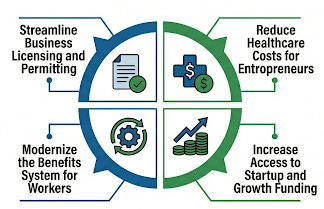
Streamline Business Licensing and Permitting
We must review outdated licensing rules and reduce startup costs. Federal and state governments should reward risk-takers, not bury them in paperwork. To solve bureaucratic delays, we should move to a “Notice Filing” system for routine approvals (similar to how the federal government handles some brewery filings). Here’s how it works: Instead of waiting months for an official to approve a permit, a small business files a notice and proceeds immediately, with the agency retaining the right to review it later. This simple change allows an entrepreneur with an idea and work ethic to get up and running immediately.
Reduce Healthcare Costs for Entrepreneurs and Small Businesses
Starting a small business is hard enough without having to worry about whether health insurance will be affordable. With insurance premiums spiking, too many small business owners are thinking about closing shop because they simply can’t afford it. How many more would-be entrepreneurs don’t even pursue starting a business in the first place because their current job offers reasonably priced health insurance? These plans should be made more affordable, even if it’s through government subsidies, as the resulting increase in new business formation will provide a return that significantly exceeds the cost.
States should facilitate large insurance pools to leverage collective buying power for small businesses. This collaboration grants smaller companies the negotiating power to access deep discounts, dramatically slashing premium costs and enabling them to affordably offer decent health plans.
Modernize the Benefits System for Workers
In today’s dynamic economy, where workers frequently change jobs or operate as contractors, we urgently need a system where core benefits are tied to the individual, not to a specific employer. This means establishing mechanisms, such as state-backed funds or platforms, that allow workers to easily accrue and carry essential perks like retirement savings and paid time off seamlessly from one role or contract to the next, ensuring economic stability regardless of employment status.
Increase Access to Startup and Growth Funding
Every entrepreneur, in every county, should be able to find startup funding. Most Main Street entrepreneurs aren’t pitching private equity firms—they are people with an idea who need $100,000 to get started. Maine Beer Company would not exist today without the SBA loan guarantees during the 2009–2010 recession. Banks weren’t lending, and we never would have obtained a loan without that program. The Obama-era recovery provision that increased the SBA loan guarantee to nearly 100% and eliminated fees were crucial; that kind of risk-mitigation should be brought back and expanded.
Provide Certainty Around Tariffs
State and federal policy should help small businesses weather global volatility, not make it worse. Tariffs need to be strategic, stable, and tied to a clear national interest so businesses can plan ahead. When tariffs are used as a political weapon, they introduce chaos that discourages domestic manufacturing and makes it harder for small businesses to price products and manage inventory.
4. Accelerate the Clean Energy Transition
The future is electrification and will make people’s lives better, through lower costs and better health. The question is whether government will help make that transition affordable and beneficial, or fight it. Right now, too many leaders in Washington are choosing the wrong path by penalizing clean-energy build-out. It is unacceptable for oil and gas to continue receiving tax breaks while credits for renewable energy face cutbacks. These actions will only increase our utility bills while making climate change worse and sacrificing our global leadership of an industry of the future.
Here are ways we can address this challenge:
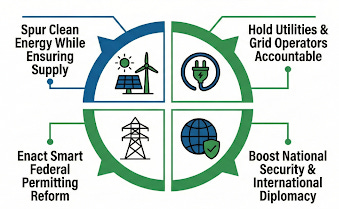
Spur Clean Energy While Ensuring Sufficient Supply During Transition
Climate change is a crisis that we must address, but we also need more clean energy to meet growing energy demand, reduce electricity bills for households and small businesses, and create good jobs. Our energy strategy must prioritize a significant increase in clean power—specifically solar, wind, and battery storage. Offshore wind development in places like Maine should ensure that building it works with established industries, like our fishermen, not against them, by respecting working waterfronts and avoiding unnecessary conflict. We should also continue to build on the success of heat pump adoption, which has accelerated here in Maine, to keep household costs from rising while cutting emissions.
I believe in an “all of the above” approach to ensure we can keep the lights on and grow our economy in the short term while making real progress in transitioning away from fossil fuels in our energy system. While I wish we could operate 100% on clean energy today, we’re just not there yet. So natural gas will inevitably play a part as a bridge fuel, and nuclear power must be included in any serious plan for decarbonization.
Hold Utilities & Grid Operators Accountable
We need to hold grid operators and utilities accountable for how they respond to rising electricity demand. Governors Josh Shapiro of Pennsylvania and Glenn Youngkin of Virginia have led the way by pushing PJM to keep costs from rising on their constituents. Entities like ISO-NE must operate with greater transparency, particularly concerning infrastructure spending and bringing more renewables onto the grid—right now, it can take years to get these sources through the generator interconnection queue. The existing structure is fundamentally flawed, as consumers face rising rates while utilities are guaranteed a rate of return. Implementing structural reforms and appointing qualified regulators to the public utilities commissions could help correct this imbalance and protect consumers.
Enact Smart Federal Permitting Reform That Adds Transmission
To unleash America’s economic potential and secure its energy future, comprehensive federal permitting reform is essential to overcome the current delays and regulatory uncertainty stifling infrastructure and energy projects.
This reform must include two core pillars: first, establishing regulatory stability by guaranteeing that projects which have successfully completed the rigorous permitting process will not face arbitrary revocation or re-litigation with a change in political priorities, thereby securing the long-term capital investments required for modern infrastructure.
Second, we must strategically address the transmission bottleneck by immediately adopting the “build the backbone first” approach, like in Texas, which prioritizes the proactive construction of primary, high-capacity transmission corridors, thereby streamlining interconnection for subsequent generation projects and drastically reducing overall costs and deployment times. The vast majority of power waiting to connect to the U.S. electric grid, amounting to over 2,600 gigawatts, consists of solar, wind, and battery storage projects, which collectively account for over 95% of the total capacity in the interconnection queue.
Boost National Security & International Diplomacy
We should treat accelerating our clean energy industry as a national security and global diplomacy priority. China has surged ahead with massive solar and wind deployment and is exporting that technology globally. There is no reason America shouldn’t be the world’s clean-energy superpower. If we don’t change course, we will miss an environmental, economic, and diplomatic opportunity.
5. Be the Party of Good Governance & Integrity
People are pissed at government, and for good reason. President Trump is the king of corruption, and the litany of examples I could cite exceeds the space available here. But it’s not just about Trump, who rode an anti-establishment wave into the Oval Office twice. Many voters currently see little difference between politicians from either party when it comes to integrity and corruption. “Politician” has become a dirty word and too many of them just confirm it by acting in self-serving ways as they seek to enrich themselves or hold onto power.
We as Democrats need to clean up our act by advocating for good governance policies, such as banning individual stock trading, conducting a clear accounting of government grift, making way for younger generations and being accountable to voters and cleaning up corruption. This is the only way we’ll regain the moral authority needed to hold Trump accountable.
Here are ways we can address this challenge:
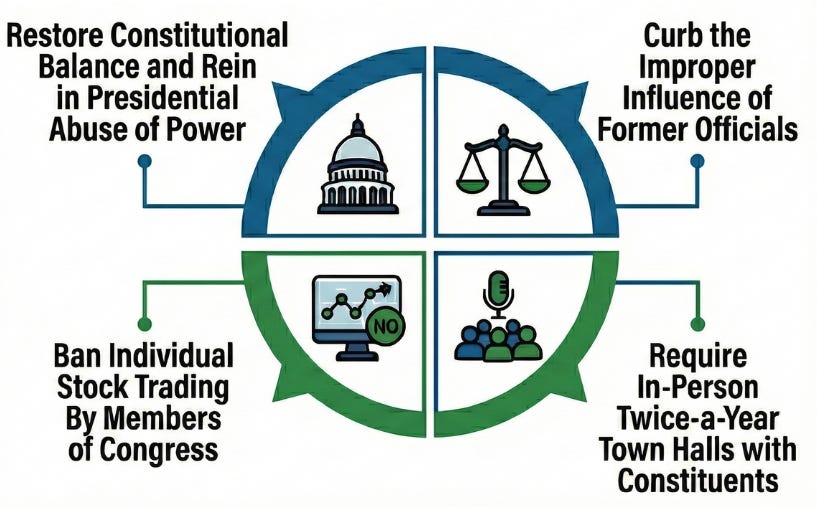
Restore Constitutional Balance and Rein in Presidential Abuse of Power
Part of why Washington is broken is that the balance of power has shifted dramatically to the Executive Branch. The gridlock on Capitol Hill over the last 15-20 years has left Presidents of both parties pursuing executive actions. Trump has significantly accelerated this trend, yet he has done so not only without significant resistance from the legislative branch but actively enabled by both Congress and the judiciary—a dynamic underscored by the Supreme Court’s critical 2024 immunity decision.
To truly restore the balance of power in Washington, we must enact rigorous laws to rein in executive overreach and end the era of government grift by reclaiming the constitutional authority of Congress. We cannot allow any president to use reckless, across-the-board tariffs as political weapons that force American small businesses to navigate constant uncertainty; trade policy must be a strategic tool managed through the constitutional process, not the whims of one person. Similarly, and as was made clear with Trump’s unilateral decision to go to war with Venezuela, we must strengthen the War Powers Resolution to ensure the solemn decision to send our service members into harm’s way is never left to unilateral executive action. We must also codify strict anti-corruption statutes that prohibit any administration from putting their finger on the scale to reward political allies or influence private business deals for personal gain.
Ban Individual Stock Trading By Members of Congress
This should be an easy step for Democrats to take. With all the non-public information they have access to, you’re asking for insider trading if you allow members of congress to trade individual stocks. Limit trading to mutual funds, exchange traded funds (ETFs) or blind trusts. This should apply to spouses and close family members, too, and penalties for violations should be steep. Mechanisms should be established to enforce this ban.
We should also address related gaps in financial ethics rules as new markets emerge. Elected officials and federal employees should be barred from trading in predictive markets when they possess or could reasonably obtain non-public information through their official duties. Representative Ritchie Torres plans to announce legislation to prohibit federal officials from participating in these markets in ways that could leverage privileged information, a concern heightened by recent profitable wagers tied to political events.
While we must also look at structural changes like term limits for Congress and the Supreme Court to bring in fresh perspectives, we have to be careful to structure these reforms so they don’t unintentionally empower unelected lobbyists and institutional staff who often exert their own will when there is political turbulence. Ultimately, the goal is to ensure that public service is defined by duty and common sense rather than self-enrichment or political games.
Curb the Improper Influence of Former Officials
To combat the improper influence of former government officials, these policies aim to increase the “cooling-off period” before they can lobby their old agencies or colleagues. Current policy allows former officials to use their connections and expertise to influence policy on behalf of private interests too quickly after leaving office. Policy ideas include lengthening the post-employment ban for Congress and senior Executive Branch officials, as well as a complete prohibition on retired senior officials lobbying on behalf of foreign governments. Additionally, the definition of “lobbying” will be expanded to ensure that all individuals seeking to influence policy, regardless of their title, are subject to disclosure rules.
Require In-Person Twice-a-Year Town Halls with Constituents
To prevent politicians from being captured by DC, we need to ensure they stay deeply connected to the people they actually represent through mandatory, in-person town halls at least twice a year. It is a simple matter of accountability—if you volunteer to run for office, you should be willing to talk to your voters on the record, even if career politicians might object. Elected officials should be more connected to their voters. This shouldn’t be too much to ask.
Conclusion
The path forward for the Democratic Party is not found in complex ideological debates but in the simple, actionable principle we use at Maine Beer Company: Do What’s Right. The five-step recipe outlined here—from making life fundamentally more affordable by building housing supply and ending reckless tariffs, to empowering small businesses through insurance pools, and ensuring the clean energy transition is affordable—is a blueprint for restoring the core promise of security and opportunity to the American people. This approach tackles the immediate, tangible stressors of daily life that Mainers, and Americans everywhere, are facing.
To regain the trust of the majority, the Party must also embody the integrity it demands of others. By pushing for clear-cut good governance reforms—banning Congressional stock trading, curbing the improper influence of former officials, and considering term limits for Congress and the Supreme Court—Democrats can prove they are not simply trading one form of corruption for another. These measures are essential to demonstrating that public service is about duty, not self-enrichment, and will restore the moral authority needed to hold opponents accountable.
This moment requires Democrats to be the party of common sense and concrete action. By focusing on security, opportunity, responsibility, and honesty, the Party can reconnect with voters who are tired of chaos and high costs. This is a framework for crafting a better, more stable future where workers can thrive, small businesses can grow, and every family can build a life without constantly struggling against rising costs. Let’s use this North Star to deliver meaningful, positive change and finally do right by the American people again. Let’s restore the American Dream.
Well thought out and well said Dan. Thank you.